Test Strips vs Liquid Test Kits: Which Is Worth Trusting for a Home Hot Tub

As an Amazon Associate we earn from qualifying purchases. Some links on this page are affiliate links, which means we may earn a small commission if you make a purchase.
At typical chlorine levels of 3–5 ppm, test strips can show a margin of error wide enough to cause a meaningful dosing mistake. This gap between convenience and precision is what makes the choice between test strips and liquid kits more than just a matter of speed.
The tool you use to test your hot tub water changes what you know, what you treat, and whether the problem comes back. Strips and liquid kits both measure the same things — pH, total alkalinity, sanitiser levels — but they do it in fundamentally different ways. One is fast and convenient. The other is precise.
Here’s how to choose the right one for your setup, your budget, and the kind of water issues that actually turn up in UK gardens.
Why Regular Water Testing Matters
Testing your hot tub water isn’t optional. It’s the step that tells you what the water actually needs versus what you think it needs. The three numbers that matter are pH, total alkalinity, and free chlorine or bromine — and they interact with each other in ways that make guesswork expensive.
The mineral content in UK tap water can shift the baseline, meaning the same dose that works for someone in a soft-water area might undershoot for you. Temperature changes throughout the year affect how quickly chemicals dissipate too — a testing routine that doesn’t adapt to seasonal shifts can lead to unexpected water problems.
The sequence matters: test first, adjust second, test again. Skipping the retest step is where many people fall down — they add chemicals, wait an hour, and jump in without confirming the numbers actually moved into range. At minimum, test once a week, or before each use if you’re using the tub more frequently. If you’ve recently treated the water for an imbalance or added a large dose of chemicals, test again the next day to confirm the numbers have actually moved into range. More frequent testing is worth it during periods of heavy use, hot weather, or when you’re troubleshooting a persistent water issue.
Getting this wrong isn’t just about cloudy water, though that’s annoying enough. Imbalanced water wastes chemicals, damages seals and heaters over time, and can irritate skin. Regular testing helps ensure the right balance of sanitiser while detecting any bacteria or contaminants that could affect water safety.
Draining and restarting after a week of bad water usually comes after money spent on chemicals trying to rescue it, when proper testing would have caught the problem before it took hold.
Test Strips: Quick Routine Checks
Test strips work on a simple principle: you dip a strip into the water, wait a few seconds for the reagent pads to change colour, then match the strip against the chart on the bottle. No mixing, no measuring drops, no waiting for a reaction to complete. Dip, wait, read.
The appeal is obvious. You can test your water quickly, which means you’re more likely to actually do it. For routine checks — confirming the tub is still balanced before a weekend soak — that’s genuinely all most people need. Strips make weekly testing feel like a routine rather than a chore. They are reliable for pH, total alkalinity, and general sanitiser levels for routine monitoring.
Clearwater Test Strips (paid link) suit exactly this job: they’re quick, the colour change is reasonably clear. The colour-matching issue does come up in buyer reviews — certain shades on the chart are harder to distinguish than others, particularly for total alkalinity where the transition between acceptable and out-of-range colours can be subtle. But for most people doing weekly checks, this isn’t a dealbreaker.
Check Clearwater Test Strips price → (paid link)
The limitation is the colour-band readout itself. Strips read in ranges, not precise numbers. pH might show “7.4–7.6” rather than “7.52”. Chlorine might show a range rather than a specific ppm value. For routine maintenance, that’s often adequate. But when water keeps going off after you’ve treated it, or when two strips from the same bottle give different readings, you need more resolution than a colour band can offer. They fall short when you need precise readings — say, confirming whether your chlorine is at 1.0 ppm or 2.0 ppm, or when you’re trying to narrow down a persistent imbalance that strips keep showing as “fine” despite the water looking wrong.
Storage matters more than most people realise. Damp strips degrade. Keeping them in a cool, dry place — the original sealed container — extends their useful life. Check the expiry date too; old strips give unreliable readings. The reagent pads degrade over time, and this process accelerates if the strips are stored in damp or warm conditions. Always check the expiry date on the bottle before use, and keep the lid firmly closed between tests. Using expired strips is one of those false economy moves that leads to wrong readings, wrong doses, and water problems that feel inexplicable until you realise the test itself was broken.
Liquid Test Kits: Precision When It Counts
Liquid test kits work differently. You fill a small comparator tube with water from your tub, add a measured number of drops of reagent, then compare the colour of the sample against a chart or disc. The process takes longer, requires more care, and involves handling chemicals — but what you get back is a number, not a range.
This matters when a water problem won’t go away. If you’ve added chlorine three times and the strip still shows “fine” but the water looks off, the strip might be the problem. Liquid kits resolve smaller differences in chemical concentration, which means you can actually see whether your chlorine is 0.5 ppm or 1.8 ppm. That’s not a cosmetic distinction — it’s the difference between water that’s protected and water that’s not.
The Lovibond Pool Water Tester (paid link) is a straightforward manual comparator that uses reagent tablets to give you a direct numerical reading. It is worth being clear about its scope: it reads free chlorine and pH, twenty tests to a pack, and nothing else — so if alkalinity is the figure giving you trouble, this is not the kit that answers it. Moving from strips to a comparator can still be eye-opening if you’ve been fighting persistent balance issues for weeks. For example, a strip that keeps showing no chlorine even when the water looks clear might indicate the strips have degraded.
Buy Lovibond Pool Water Tester on Amazon → (paid link)
The trade-off is time and technique. With a liquid kit, you’re measuring drops, timing reactions, and matching colours under light conditions that can affect what you see. The learning curve is real — reading a result too early or too late changes the colour. Getting consistent results from a liquid kit takes a few practice runs. But once you’ve got the technique, the readings are more reliable.
Reagents are an ongoing cost. The kit itself is typically a one-time purchase, but the reagents need replacing as you use them.
Making Your Choice: Practical Scenarios
Here’s the honest answer: both have a legitimate place in a hot tub owner’s toolkit, and the question isn’t which one is better — it’s which one does the job you need right now.
Test strips are fine for routine checks if they are fresh and stored dry. They’re fast, convenient, and give you enough information to know whether your water is broadly in range. If you’re testing weekly, using the tub at weekends, and your water hasn’t given you any trouble, strips are all you need.
A liquid kit earns its place when a problem keeps coming back and you need to know exactly which number is off. If you’ve treated the water twice and it’s still not clearing up, or if you’re getting conflicting readings from different strips, the precision of a liquid kit stops you from guessing your way through a problem that a number would solve.
The decision framework is simple:
- Routine checks? → Test strips. Weekly balance checks, pre-use confirmation, general monitoring. Fast and enough.
- Persistent problem? → Liquid kit. Water that won’t clear, readings that don’t make sense, or ongoing balance issues.
- Tight budget? → Test strips, but store them properly. A fresh bottle of strips costs a few pounds and will give you reliable readings for routine use.
The honest answer is that most UK hot tub owners could start with strips and never need more. But the ones who’ve been through a week of cloudy water, four bottles of clarifier, and two different chemicals before figuring out the pH was off — they tend to keep a liquid kit in the garage after that. It’s not about which tool is better. It’s about having the right one for the job.
Comparing the Two Methods
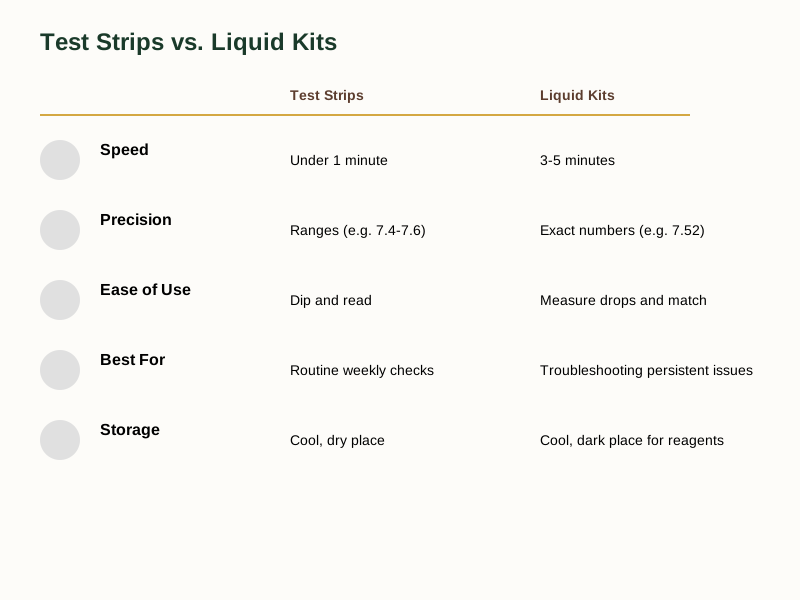
| Feature | Test Strips | Liquid Test Kits |
|---|---|---|
| Speed | Quick | Takes more time |
| Precision | Ranges (e.g., 7.4–7.6) | Exact numbers (e.g., 7.52) |
| Ease of Use | Dip and read | Measure drops and match |
| Best For | Routine weekly checks | Troubleshooting persistent issues |
| Storage | Cool, dry place | Cool, dark place for reagents |
From Testing to Dosing
The relationship between testing accuracy and dosing accuracy is direct — your chlorine dosing guide assumes a reliable test reading. The test method is only half the equation; once you have an accurate reading, you can calculate the right dose for your specific tub volume.
For routine maintenance, start with quality test strips, keep them dry, and check them weekly. If you hit a water problem that keeps coming back despite treatment, that’s when a liquid kit earns its place — and once you’ve got one, you’ll understand why owners who’ve been through a stubborn balance issue reach for it first.
If you’re not sure whether your current routine is testing the right things at the right times, grab the free checklist — it’s a straightforward audit of the decisions that actually keep UK hot tub water clear and balanced.
Related Guides
The Minimum Chemical Kit for an Inflatable Hot Tub (and What You Can Skip)
Sources & Further Reading
As an Amazon Associate we earn from qualifying purchases. The kit linked above is gear we recommend based on independent research and owner feedback.
Note: General guidance only, verify details with a qualified professional or official source.